How to Make Your Home Office Feel Less Like a Cubicle

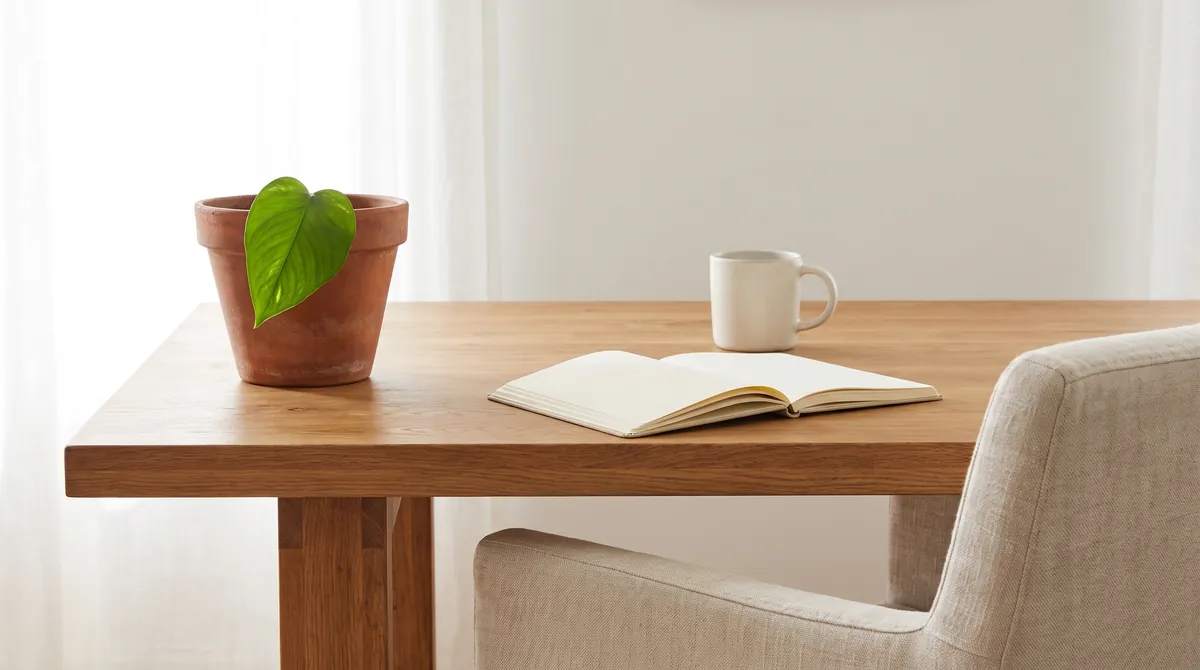
A cozy home office is one where you don't spend the first 20 minutes of your workday dreading the space itself. The changes that matter most are smaller and cheaper than most people expect: light temperature, one plant, a rug. This guide covers the specific upgrades that move the needle, backed by real research, with honest numbers attached. Many of these same principles apply to the rest of your home. The budget cozy home decor guide covers the living room and bedroom version of this thinking.
TL;DR
- The $50 fix: a warm 2700-3000K desk lamp (the IKEA Forså is about $13) plus a rug ($25-40).
- Workspace quality predicted productivity more than any scheduling system in TU Darmstadt research (path coefficient 0.547).
- One plant cut dry-air complaints from 45% to 23% in a 2023 nine-organization study.
Why Your Setup Matters More Than Your Schedule
You can optimize your calendar perfectly and still feel terrible in a cold, harsh room. Workspace design is not decoration. It is performance infrastructure.
A 2022 study from the Technical University of Darmstadt looked at hundreds of remote workers and found that equipment and physical workspace quality was the strongest predictor of productivity, with a satisfaction-to-productivity path coefficient of 0.547. That is a large effect. It means the ergonomics of your chair, the quality of your light, and how much you actually like being in the room are doing more work than most productivity systems people obsess over.
A separate 2022 analysis published in PMC found that higher satisfaction with home office characteristics correlated directly with lower burnout scores. The workspace is not a neutral container. It is part of the job.
The trap most remote workers fall into is treating the home office as a temporary arrangement even years into it. They use whatever desk they owned before, keep a harsh overhead bulb because it was already there, and put nothing on the walls because they keep meaning to do it properly later. Later never comes. The half-finished space stays half-finished, and every time you sit down to work, you feel that incompleteness.
Fix the space once, fix it intentionally, and you stop spending mental energy on it.
The $50 Fix Most People Ignore
A desk lamp with a warm bulb and a small rug. That is the $50 fix.
Most people skip both because neither feels essential. Both are essential.
The rug matters because hard floors in a small room create a particular kind of acoustic harshness. Sound bounces. It makes the space feel louder and colder without you consciously registering why. A rug from IKEA or Amazon Basics costs $25 to $40 and absorbs that reflected sound immediately. You will notice the change within a day, even if you cannot explain it.
The lamp matters for the same reason the overhead light fails: overhead light is flat and institutional. It is exactly what an office park installs because it is cheap and scalable. A small desk lamp with a 2700K to 3000K bulb (warm white, not cool white or "daylight") creates a pool of directed, warm light at eye level. The IKEA Forså lamp costs around $13. The BenQ ScreenBar is $109 if you want something that clips to the monitor and has zero footprint. Either way, it is the highest-ROI change you can make.
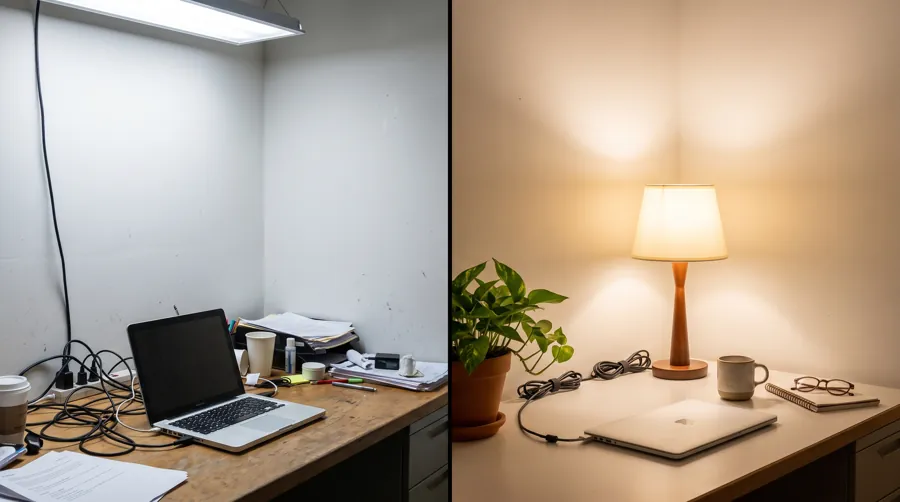
If you have $50 total, spend $25 on a rug and $13 on an IKEA lamp. Spend the remaining $12 on a potted plant at a garden center (not a grocery store, where they are usually root-bound and half-dead already).
Lighting: The One Thing That Changes Everything
There is a reason photographers talk about light before everything else. Light shapes how a space feels at a physical level that most other design choices cannot override.
Color temperature is measured in Kelvin. Lower numbers are warmer (orange-yellow). Higher numbers are cooler (blue-white). Most homes ship with 5000K daylight bulbs or cheap 4000K cool white because manufacturers buy in bulk and daylight bulbs look bright in the box. They are also the reason your home office looks like a hospital waiting room.
For a cozy home office, stay between 2700K and 3000K. That range mimics late-afternoon sunlight. It is warm without being dim. Philips Hue bulbs let you set this precisely and dim them in the afternoon when natural light changes. A standard A19 warm white bulb from any hardware store costs $4 to $6 and produces the same effect without the smart-home premium.
Natural light positioning matters more than any bulb. If you can place your desk perpendicular to a window (not facing it, not with it behind you), you get soft, indirect daylight that reduces eye strain and keeps you oriented to the outside world. Facing a window creates glare. Window behind you creates screen reflection. Perpendicular is the target.
One more thing: floor lamps placed behind your monitor or in a corner create depth. Flat overhead light creates flatness. Depth makes a room feel larger. That is not a metaphor; it is how the eye reads space.
Plants: Yes, They Actually Work
This is the part where a lot of home office guides say "plants can make a space feel more alive" without citing anything. Here is the actual research.
A 2023 study from Wageningen Environmental Research tracked workers across nine Dutch organizations before and after adding indoor plants. Dry air complaints dropped from 45% to 23%. Workspace satisfaction improved and those gains held for over four months. This was not aromatherapy or placebo territory; humidity levels measurably changed. Indoor plants, especially broader-leafed varieties, transpire water and genuinely affect air quality in a small enclosed room.
Harvard Business Review covered related research in July 2023, examining how micro-nature elements (a small plant, a view of a tree, anything biophilic) improve both mood and output in knowledge work. The mechanism is attention restoration: looking at living things gives the prefrontal cortex a brief reprieve from directed focus. Brief is enough.
The best plants for a home office desk or shelf, in order of difficulty to kill:
- Pothos (Epipremnum aureum): tolerates low light, infrequent watering, forgetfulness. Vines trail nicely off a shelf.
- ZZ plant (Zamioculcas zamiifolia): needs water once every two to three weeks. Nearly indestructible. Good for cold or north-facing rooms.
- Snake plant (Dracaena trifasciata): upright, architectural, happy in indirect light. Produces oxygen at night, making it a good bedroom-desk option too.
- Peace lily (Spathiphyllum): one of the few flowering office plants that tolerates shade. Droops dramatically when it needs water, so you always know.
- Chinese evergreen (Aglaonema): wide variety of leaf patterns, extremely tolerant of neglect, stays compact.
One medium plant on the desk is enough to register visually and functionally. You do not need a jungle. You need one living thing that is not a screen.

Small Textures, Big Difference
Cubicles are cold because they use industrial materials: synthetic carpet tile, laminate surfaces, particle board, wire management panels. Every surface is hard, flat, and uniform. That uniformity is what makes them feel institutional.
You break that feeling by introducing textural contrast: one soft thing, one natural material, one warm surface.
The soft thing: a throw over the back of the chair, a cushion on a hard seat, or that rug already mentioned. Textiles absorb sound and signal comfort. A $15 throw from Target works as well as one that costs four times more.
The natural material: wood, stone, ceramic. A wooden desk organizer from a thrift store, a small ceramic mug holding pens, a stone coaster under your coffee cup. These things are cheap, often secondhand, and visually break up the uniformity of plastic and metal.
The warm surface: the desk itself, if you can swing it. A solid wood desk runs $200 to $400 from IKEA's solid pine range (IVAR, LISABO). A butcher block countertop cut to desk dimensions costs $80 to $150 from most hardware stores and needs only sanding and oil. These are real investments, but they last a decade and make every hour at the desk feel different.
If none of that is in the budget: a $3 beeswax candle from a farmer's market, lit for the first hour of work each morning, introduces scent, warmth, and a focal point that signals "this is a space I chose." Tiny, but real.
Making It Yours (Without Clutter)
This is where cozy minimalist home sensibility becomes practical. Personal objects are not clutter. Clutter is personal objects without intention. If the desk is just one piece of a bigger picture, the slow living guide covers how deliberate attention to your physical environment connects to a calmer daily pace overall. And if the whole space needs a reset first, start with the weekend declutter checklist before adding anything new.
The rule that works: one shelf, fully curated. One shelf (or a section of the desk surface) is designated for objects that mean something to you. A photo, a postcard, one small piece of art, a book spine you like looking at. That shelf gets attention; the rest of the desk stays clear.
Below is a quick decision framework for whether something belongs in the office:
| Object | Keep it if... | Remove it if... |
|---|---|---|
| Art or photo | You look at it and feel something positive | You never notice it anymore |
| Desk object (stapler, tape, etc.) | You use it at least once a week | It just migrated there from elsewhere |
| Cables | They're routed and out of sight | They're loose on the desk or floor |
| Books | You reference them or they're decorative spines you chose | They're there by default, gathering dust |
| Extra monitors, peripherals | You use them daily | They were here before you organized anything |
Cable management is the part most people delay indefinitely. VELCRO cable ties cost $7 for a pack of 50. An hour with those and a cable tray (around $12 on Amazon) removes the visual noise that makes a desk feel chaotic regardless of what else you do to the room.
A Real Makeover Worth Watching
Before going out and buying anything, it helps to see a real transformation play out from start to finish. This video walks through a complete home office makeover with decisions explained in real time, from a blank or cluttered starting point to a finished, warm setup. Watch especially for how light placement is handled and where the budget gets prioritized.
After watching, you'll likely notice the same thing most people do: the biggest visual shifts came from the cheapest changes. A warm lamp, a plant, a rug. The expensive pieces were secondary to the foundational lighting and layout decisions.
Key Takeaways
- Workspace quality is a stronger productivity predictor than schedule optimization, according to TU Darmstadt research.
- Switch overhead lights for a 2700K-3000K desk lamp. Under $15 for the IKEA Forså; under $25 for any good warm-white LED lamp.
- One rug, even a cheap one, reduces acoustic harshness and signals comfort.
- One real plant (pothos or ZZ if you're forgetful) measurably improves air quality and workspace satisfaction.
- Textural contrast (one soft thing, one natural material) breaks institutional uniformity without costing much.
- One curated personal shelf is the difference between a bare room and a room that's yours.
- Cable management is boring but it is 20% of the visual cleanup in most home offices.
- For more ideas on creating comfortable, intentional home spaces, browse the home and living category.
Frequently Asked Questions
What makes a home office cozy?
Warmth in the literal and physical sense: warm-toned lighting (2700K to 3000K), soft textures like a rug or throw, at least one plant, and personal objects that were chosen rather than inherited by default. The research from TU Darmstadt shows workspace satisfaction has a direct, measurable effect on productivity, so "cozy" is not just aesthetic preference. It is functional design.
How do I make my home office look nice on a budget?
Start with the three cheapest, highest-impact changes: a warm desk lamp ($13 to $25), a rug ($25 to $40), and one plant from a garden center ($8 to $15). Combined that is under $80 and it transforms most spaces more than a new desk or monitor arm would. After that, cable management with VELCRO ties ($7) and one piece of art from a thrift store or printed from a free print-at-home site finishes the job.
What plants are best for a home office?
Pothos and ZZ plants are the most forgiving for people who travel, get busy, or do not have strong natural light. Both tolerate irregular watering and low light. For better light conditions, snake plants and Chinese evergreens stay compact and need minimal maintenance. Peace lilies work well if you want something that flowers and you have indirect light. Avoid ferns and calatheas unless you are confident about consistent humidity and watering schedules; they punish neglect quickly.
How do I reduce noise in my home office?
Hard floors and bare walls are the main culprits. A rug handles floor reflections; a bookshelf, gallery wall, or fabric panel handles wall reflections. For external noise (traffic, neighbors), a white noise machine on the desk runs $25 to $40 and is far more effective than earplugs for sustained focus work. Heavy curtains do double duty, blocking both sound and harsh afternoon light. If you are on video calls frequently, a USB dynamic microphone (the Samson Q2U at $60 or the Audio-Technica ATR2100x at $79) cuts ambient noise far better than laptop or headset mics.
Sources
- Voll, S., Gauger, T., & Pfnür, A. (2022). "A Corporate Real Estate Management Perspective on Home Office." International Journal of Environmental Research and Public Health. https://pmc.ncbi.nlm.nih.gov/articles/PMC9243809/
- de Vries, S., Hermans, T., & Langers, F. (2023). "Effects of indoor plants on office workers." Wageningen Environmental Research / PMC. https://pmc.ncbi.nlm.nih.gov/articles/PMC10346441/
- Klotz, A., McClean, S., & Tang, P. M. (July 2023). "Research: A Little Nature in the Office Boosts Morale and Productivity." Harvard Business Review. https://hbr.org/2023/07/research-a-little-nature-in-the-office-boosts-morale-and-productivity
- Satisfaction with home workspace characteristics and mental health (2022). PMC. https://pmc.ncbi.nlm.nih.gov/articles/PMC9135482/
Wellness Tabloid is reader-supported: this page shows ads and some outbound links may be affiliate links.
Fact-checked against cited sources. Reviewed by the Wellness Tabloid editorial team.