What Is a Low-Dopamine Morning Routine and Why Everyone Is Trying It


A low-dopamine morning routine means spending the first 30 to 60 minutes of your day deliberately avoiding anything that floods your brain with fast dopamine hits, especially your phone. The idea is simple: when you keep stimulation low early on, your dopamine baseline stays steadier, and you can actually concentrate on things that matter without needing a constant stream of novelty to function.
It sounds counterintuitive. Most productivity advice tells you to seize the morning. This one asks you to do almost nothing. That's exactly why it works for a lot of people, and why it quietly spread from ADHD communities on TikTok into the broader conversation about attention and mental health. If you're looking for the broader picture of what a no-fuss morning looks like alongside this, the morning routine checklist for non-morning people covers the practical side well.
TL;DR
- What it is: spend the first 30 to 60 minutes after waking without your phone or other fast-stimulation inputs.
- Why it works: you skip the early dopamine spike and the dull, irritable crash that follows, so attention holds steadier.
- Best first steps are morning light and gentle movement (no screen); most people feel a difference within one to two weeks.
What Dopamine Actually Does in the Morning
Most people learn in school that dopamine is the "pleasure chemical." That framing misses most of what it does. Dopamine drives motivation, anticipation, and the seeking of reward. It fires before you get the thing you want, not really after. When you wake up and immediately open Instagram or check Slack, you're triggering a dopamine release tied to novelty and social comparison, before your brain has even fully oriented to the day.
The problem is the trough that follows every peak. Dr. Anna Lembke, a Stanford psychiatrist and the author of Dopamine Nation, explains it as a pleasure-pain balance: when dopamine spikes, your brain compensates by pushing toward the "pain" side to restore equilibrium. That's the dull, vaguely irritable feeling you get 20 minutes after you've been scrolling for no reason. You're not bored; your baseline has dropped.
A 2021 study published in iScience measured striatal dopamine synthesis capacity in 22 healthy adults using PET imaging, then tracked their smartphone social app use over several weeks. Higher proportions of social app interactions correlated with lower dopamine synthesis capacity in the bilateral putamen. In plain terms: more social scrolling was associated with a reduced ability to produce dopamine naturally (Martins et al., 2021).
That's one study, not a verdict. But it fits a pattern that's building in the literature. A 2025 paper in Frontiers in Public Health identified "dopamine-scrolling" as a distinct behavioral pattern worthy of public health attention, noting that the variable reward schedule of social feeds shares structural features with slot machine mechanics (Sharpe and Spooner, 2025).
Why the Morning Window Matters More Than Any Other Time
Your brain is not the same at 7 a.m. as it is at 2 p.m. Cortisol peaks in the first hour after waking, a normal and healthy part of your circadian rhythm called the cortisol awakening response. This peak is part of what primes attention and alertness. Andrew Huberman, a neuroscientist at Stanford, has written extensively about how morning sunlight exposure interacts with this window: getting outside within 30 to 60 minutes of waking amplifies the cortisol peak and helps anchor your circadian clock, which in turn stabilizes mood and sleep later in the night (Huberman Lab).
When you replace natural light and quiet orientation with a phone screen, you're hijacking that window. You're not just checking messages; you're setting the neurological tone for how your attention and reward circuits operate for the rest of the day.

What a Low-Dopamine Morning Routine Actually Looks Like
There's no official protocol. The core principle is: delay high-stimulation inputs. Here's a practical structure that many people start with, adjusted to real life:
- No phone for 30 to 60 minutes after waking. Put it in another room the night before. The friction of fetching it is enough to break the reflex.
- Get natural light on your face. Step outside, even for five minutes. On cloudy days, research suggests outdoor light still delivers enough lux to trigger the circadian signal. A window doesn't cut it because glass filters the spectrum.
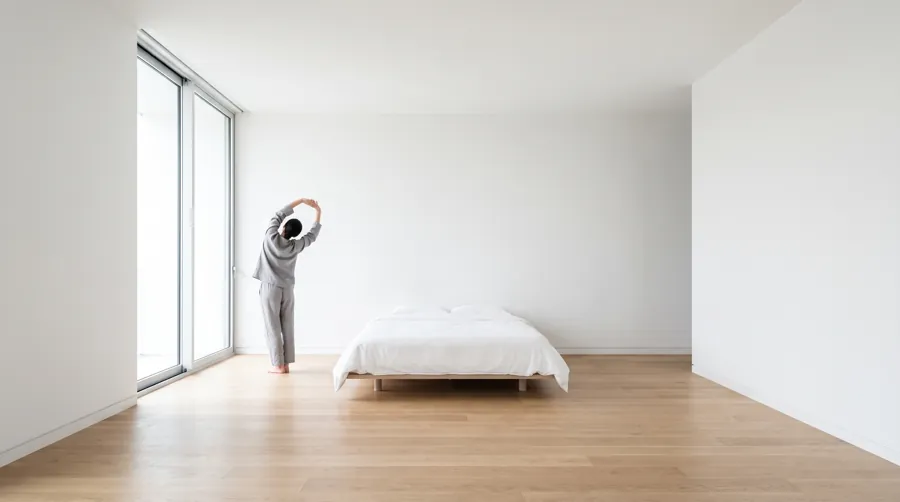
- Do something physical and low-stakes. Make your bed. Stretch for five minutes. Walk around the block. The bar is low on purpose. The point is movement, not a workout.
- Eat before caffeine, or wait 90 minutes before coffee. Huberman's suggestion to delay caffeine by 90 to 120 minutes is based on adenosine clearance, the idea that your body clears the sleep-pressure chemical naturally in the first hour or two, and caffeine before that can leave you with a sharper crash later. This one is debated, but a lot of people notice a difference when they try it. While you're waiting on the coffee, a glass of water with a pinch of salt is a genuinely useful alternative; the morning hydration research explains why.
- If you write or journal, do it now. This is the window when your thinking tends to be least reactive and most generative. Even five minutes of freewriting counts.
Notice what's not on this list: a 45-minute meditation, a cold plunge, a five-mile run, or a perfect green smoothie. Those things are fine if you genuinely want them. But they're not the mechanism. The mechanism is the absence of high-stimulation inputs, not the addition of impressive ones.
Who Benefits Most (and Who Might Not)
The low-dopamine morning has become particularly popular in ADHD communities, and for good reason. When your dopamine regulation is already effortful, starting the day with a spike-and-crash cycle is especially costly. The Inflow ADHD resource team notes that external cues and environmental structure matter a lot for ADHD mornings, and removing the phone removes one of the most powerful environmental cues to spiral (Inflow).
That said, it doesn't work the same for everyone. Some people, particularly those whose dopamine is already running low in the morning, find that withholding all stimulation leaves them foggy and demotivated rather than focused. If the low-stimulation approach leaves you staring at the wall for an hour and still can't start anything by 9 a.m., you might need a gentle activation, movement, music, or light social contact, before restricting inputs. A quick 15-minute bodyweight session can serve that role without adding screens. The goal is a functional, grounded start to the day. There's no prize for suffering through a method that doesn't fit your brain.
The Difference Between Low Dopamine and No Dopamine
This is worth being precise about. "Low dopamine morning routine" is a catchy phrase that's slightly misleading. You cannot stop your brain from releasing dopamine. You do not want to. Dopamine is not a limited resource you're hoarding for later. What you're actually doing is avoiding a fast, steep spike, the kind that comes from social media's variable reward schedule, because steep spikes are followed by proportional troughs, and those troughs make calm, sustained attention harder to access.
A walk outside produces some dopamine. So does a good cup of coffee, a few minutes of journaling, or hearing a song you like. None of those are problems. The distinction is between slow, natural rises in dopamine and the sharp artificial spikes that come from notification pings, infinite scroll, and the algorithmic drip of social content.
How to Watch This in Practice
This video from 2025 walks through building a low-dopamine morning routine with a focus on breaking the morning scrolling reflex:
The practical framing in this video is useful: it focuses on the environment design piece rather than willpower. Leaving your phone charger in the kitchen is more reliable than deciding every morning not to check it. For the bigger-picture version of the same principle, a digital declutter across your devices removes the apps and notifications that make the phone so hard to ignore in the first place.
A Simple Comparison: Phone-First vs. Low-Dopamine Morning
| Phone-First Morning | Low-Dopamine Morning |
|---|---|
| Wake up, check notifications immediately | Wake up, phone stays in another room |
| Dopamine spike from social/news feed | Gradual cortisol and dopamine rise via light and movement |
| Reactive thinking triggered by others' content | Self-directed attention on your own priorities |
| Post-scroll dopamine trough mid-morning | Steadier baseline, easier to sustain focus |
| Caffeine often consumed before adenosine clears | Caffeine delayed; less afternoon crash reported |
Key Takeaways
The healthy habits section has more morning-focused articles if you want to build out the full routine.
- A low-dopamine morning routine delays high-stimulation inputs (especially your phone) for 30 to 60 minutes after waking to protect your dopamine baseline.
- Dopamine spikes are followed by troughs; the goal is a gradual, natural rise, not a fast spike from social feeds or notifications.
- Morning sunlight, gentle movement, and no phone are the three most evidence-supported starting points.
- The approach works especially well for people with ADHD or those who notice mid-morning focus crashes after a phone-heavy start.
- It's not about eliminating dopamine. Coffee, music, journaling, and light social contact are all fine; slot-machine-style scrolling is what you're avoiding.
- Environment design beats willpower: charge your phone in a different room.
Frequently Asked Questions
Is a low-dopamine morning routine the same as a dopamine fast?
No. A dopamine fast, popularized around 2019, involves avoiding all pleasurable stimuli for extended periods, sometimes a full day. A low-dopamine morning routine is far narrower: it just asks you to skip high-stimulation inputs for the first 30 to 60 minutes of your day. You're not fasting from dopamine; you're avoiding a spike-and-crash cycle in a vulnerable neurological window.
What if I need to check my phone first thing for work?
Even 15 minutes of delay is better than zero. Some people set a rule: no phone until after they've had water and stepped outside, even briefly. If your job genuinely requires immediate early-morning availability, try limiting the first check to one specific channel (email, not social) and setting a hard time to stop before moving into the rest of your routine.
Does coffee count as a high-dopamine input?
Coffee is a stimulant, but its primary mechanism is adenosine blocking, not a direct dopamine surge the way social media is. Many people keep coffee in their low-dopamine mornings and find it perfectly compatible with the approach. The Huberman Lab suggestion to delay coffee by 90 minutes is about optimizing adenosine clearance, not avoiding dopamine. If black coffee before a phone-free walk works for you, that's a reasonable routine.
How long does it take to notice a difference?
Most people who report benefits notice something within one to two weeks of consistent practice. Dr. Lembke's research on dopamine pathways suggests that meaningful recalibration of reward circuits after chronic overstimulation takes around 30 days of reduced input. For a lower-stakes habit like a phone-free morning (rather than quitting a substance), you're likely looking at a shorter timeline for noticeable focus improvements, but individual variation is significant.
Sources
- Martins, D. et al. (2021). Striatal dopamine synthesis capacity reflects smartphone social activity. iScience, Cell Press.00465-X)
- Sharpe, L. and Spooner, R. (2025). Dopamine-scrolling: a modern public health challenge requiring urgent attention. Frontiers in Public Health. PubMed Central.
- Huberman Lab Newsletter: Using Light for Health. Andrew Huberman, Stanford University.
- Inflow ADHD: How to Build an ADHD Morning Routine Using the Low-Dopamine Approach.
- Huberman Lab Newsletter: Tools to Manage Dopamine and Improve Motivation and Drive.
Wellness Tabloid is reader-supported: this page shows ads and some outbound links may be affiliate links.
Fact-checked against cited sources. Reviewed by the Wellness Tabloid editorial team.